
Views: 0 Author: Site Editor Publish Time: 2026-09-25 Origin: Site
Walk onto any traditional stationery factory floor, and you will immediately notice the logistical strain. Workers constantly sweat over heavy pallets, moving towering stacks of semi-finished paper between standalone machines. High labor costs, inconsistent production times, and the sheer physical toll of manual transport eat into manufacturing profits every single shift. Every time a worker shifts materials from a printing press to a folding station, the facility loses valuable time. Worse, this manual handling drastically increases the risk of product damage.
To overcome these costly operational bottlenecks, plant managers are turning to fully automated systems. By utilizing a continuous manufacturing concept known as reel-to-book integration, these advanced systems transform a raw roll of paper into finished, counted, and trimmed notebooks in one synchronized pass. This technological leap solves the workflow problem. It virtually eliminates the need for human intervention during the core production cycle.
In this comprehensive engineering guide, we will explore exactly how this automation works. You will learn the mechanics behind these integrated systems, examine their core components, and understand how upgrading your equipment drastically reduces manual handling while scaling your factory output.
Reel-to-Book Efficiency: Fully automatic systems process raw paper reels and output retail-ready exercise books. This completely eliminates intermediate manual sorting, stacking, and physical transport between stations.
Labor Cost Reduction: Automating the entire manufacturing sequence drastically reduces reliance on manual labor. Facility managers can then reallocate staff to quality control or final packaging.
All-in-One Integration: Modern production lines seamlessly combine high-speed printing, folding, wire stitching, and edge trimming into one continuous workflow.
Measurable ROI: Reduced material waste, lower hourly payroll, and significantly faster production speeds lead to a rapid Return on Investment for industrial manufacturers.
Recent market intelligence reveals a profound shift in how educational and office stationery is manufactured today. Driven by global supply chain pressures and tightening profit margins, the industry is rapidly pivoting away from fragmented setups. A shrinking pool of manual laborers willing to perform heavy lifting has accelerated this transition.
Industry analysts note that global demand for standardized notebooks remains robust. However, wholesale buyers now demand faster turnaround times and stricter quality uniformity. Consequently, manufacturers are treating automation not merely as an optional upgrade, but as a survival imperative. From an engineering standpoint, reducing touchpoints is the only reliable way to meet these high-volume, low-margin demands while maintaining strict quality control.
Historically, manufacturing a standard school notebook was a highly segmented endeavor. Older methods mandated isolated machines for each distinct phase of production. Facilities operated distinct zones. One area handled ruling the paper, another cut the sheets, and separate zones managed collating, binding, and trimming. This fragmented approach required workers to physically drag pallets of semi-finished paper across the floor. This created severe logistical bottlenecks and introduced the constant risk of paper misalignment and contamination.
To address these compounding inefficiencies, equipment engineers developed the fully integrated exercise book production line. This transition marked a paradigm shift in factory operations. Instead of managing a disjointed sequence of independent machines, modern engineering linked them into a single cohesive unit. Today, this technology stands as the baseline standard for competitive manufacturers who need to fulfill large contracts under strict deadlines.
At the heart of modern stationery manufacturing is the reel-to-book concept. In practical terms, this integration describes a seamless, uninterrupted production cycle. A massive continuous reel of raw paper feeds into the starting point of the machine. Minutes later, a neatly stacked pile of finished notebooks emerges at the discharge conveyor.
This continuous workflow relies on precise mechanical synchronization and advanced sensor technology. First, a forklift operator loads a raw paper roll onto a pneumatic expanding shaft. Magnetic powder brakes and automated web guides take over, maintaining precise tension to ensure the paper feeds smoothly at high speeds. The continuous web passes through printing cylinders, gets sliced into individual sheets by a rotary cutter, and is electronically counted into precise groupings.
Following collation, a separate feeder mechanism accurately drops a heavier-weight cover onto the stack. Finally, the machine binds the pages, folds them down the center spine, and trims the rough outer edges. The primary operational advantage here is the no-touch environment. Once the technician inputs the dimensional parameters into the main control panel, human hands do not intervene.
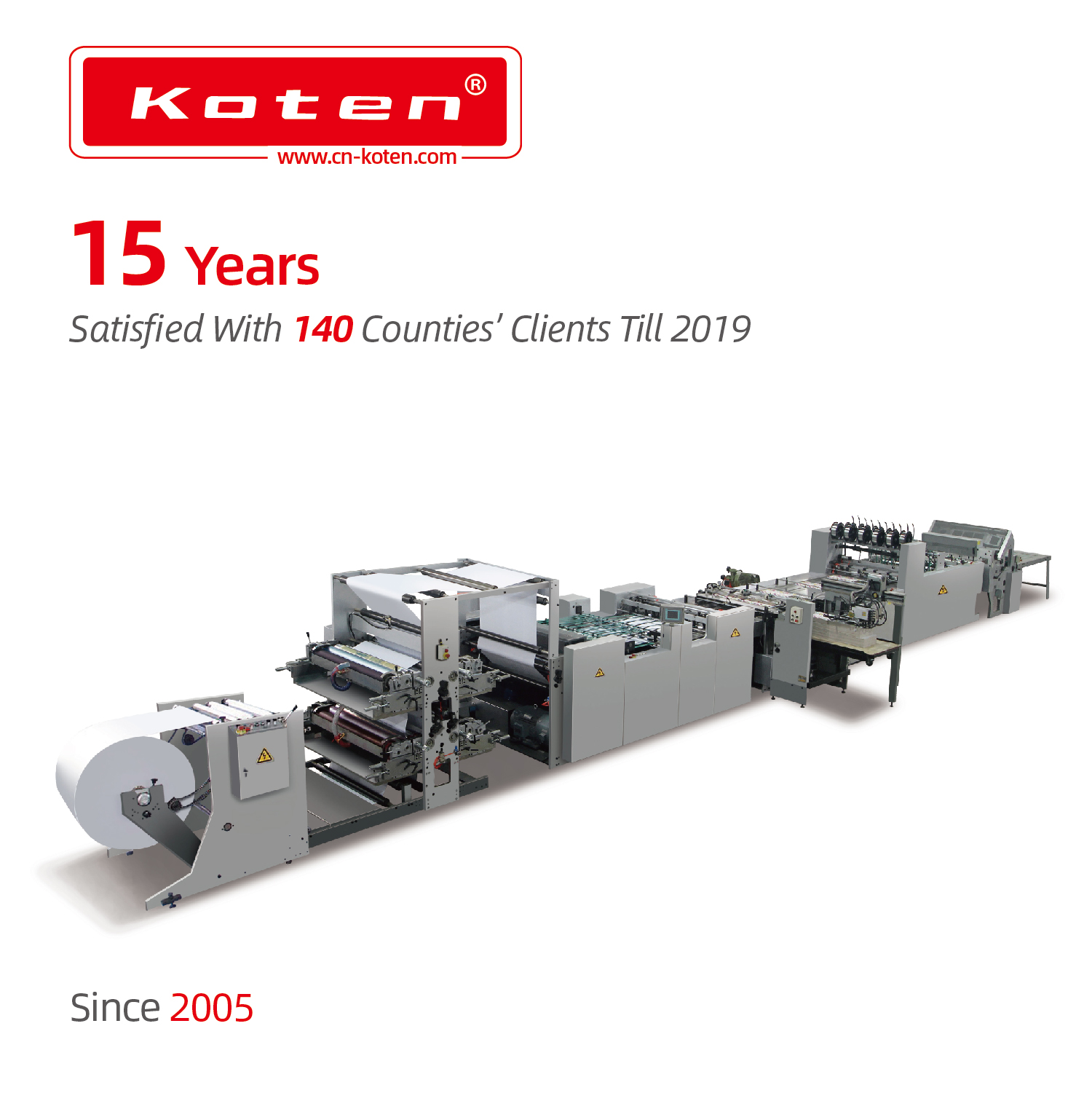
Understanding the mechanical architecture is essential for facility managers evaluating an equipment upgrade. These setups are complex assemblies of specialized modules working in perfect tandem.
The initial phase is executed by the flexo ruling machine. Engineered for high-speed flexographic printing, this section applies two-sided ruling onto the moving web of paper. Industrial models typically support web widths up to 1020mm and operate at speeds reaching 250 to 300 meters per minute. Utilizing flexible photopolymer plates and fast-drying water-based inks, this component is highly efficient. Advanced photoelectric sensors ensure that the lines printed on the front of the page align perfectly with the back.
Once the paper is cut and collated with its cover, it enters the stitching folding machine. This critical module dictates the structural integrity of the notebook. Side-lay guides align the collated stack perfectly. Heavy-duty stitching heads then draw from spools of galvanized metal wire, driving saddle-stitches directly through the spine. Immediately following this, mechanical folding blades push the stitched spine through heavy steel compression rollers. This spine-pressing action forces the book to lie flat, eliminating the springy bulking effect that plagues poorly manufactured stationery.
The final mechanical phase occurs within the book trimming machine. After folding, the outer edges of the notebook are naturally uneven. This module uses high-speed hardened steel knives to perform deep cuts along the top, bottom, and fore-edge. Unlike manual guillotine cutters where an operator must manually jog the paper, automated trimmers use pneumatic clamps to hold the book securely. High-power waste extraction vacuums immediately suck away the paper offcuts, preventing mechanical jams.
To truly grasp the impact of reel-to-book technology, we must look at the data. Below is a direct comparison between traditional segmented manufacturing and fully automated lines.
| Metric | Segmented / Semi-Auto Process | Fully Automatic Reel-to-Book |
|---|---|---|
| Labor Requirement | 8 to 12 operators across multiple machines | 1 to 2 skilled technicians |
| Production Speed | Highly variable, limited by manual transport | Up to 45 cycles/min or 100,000+ books/shift |
| Material Waste | High due to manual handling and jogging damage | Minimal, optimized by automated tension control |
| Product Consistency | Inconsistent margins and staple placement | Mathematically exact millimeter precision |
| Floor Space | Requires massive staging areas for WIP inventory | Compact linear footprint, zero WIP staging needed |
For decision-makers evaluating manufacturing equipment, the dramatic reduction of manual handling is often the most compelling justification for capital expenditure. In industrial environments, every manual touchpoint is an opportunity for delay or workplace injury.
Traditional setups create inherent production bottlenecks. For instance, a printing press might output 10,000 sheets an hour. If the manual binding station can only process half that amount, semi-finished inventory quickly piles up on the factory floor. Reel-to-book integration eliminates these synchronization issues entirely. Because all modules are electronically linked via a central Programmable Logic Controller, the speed of the unwinder strictly dictates the speed of the trimmer. This ensures a smooth output rate without pile-ups.
Furthermore, moving heavy stacks of paper is physically demanding. A standard pallet of printed paper can weigh hundreds of kilograms. Workers repeatedly lift, twist, and load these stacks, leading to musculoskeletal fatigue. Upgrading to a modern notebook making machine removes this physical burden, creating a fundamentally safer workplace.
Relying on manual labor also introduces the unpredictable variable of human error. When a fatigued operator attempts to jog stacks of paper into a cutter, slight misalignments are practically inevitable. Automated sensors and servo motors guarantee precision down to the millimeter, ensuring a level of standardization that human hands simply cannot sustain over an eight-hour shift.
Procuring automated manufacturing equipment is a major capital expenditure. Facility managers must evaluate specific technical criteria to ensure the chosen machinery aligns perfectly with their production goals. Do not just look at the price tag; look at the engineering specifications.
First, evaluate the maximum web width and cutting dimensions. A versatile machine should have the mechanical flexibility to switch between different standard book sizes such as A4, A5, and B5. Check the specified cut-off length range. Equipment that supports a wider range allows you to take on diverse custom orders.
Next, inspect the control systems. The usability of the machine dictates its daily efficiency. Modern equipment should feature intuitive touchscreen interfaces linked to robust PLCs from reputable brands like Siemens or Yaskawa. Systems offering automatic fault detection and real-time production monitoring make troubleshooting highly efficient for the operator.
Finally, durability cannot be compromised. These machines are designed to run continuously in demanding environments. Look for heavy-duty cast iron frames that absorb vibration during high-speed operation. Internal components like cutting cylinders and folding blades should be CNC-machined from high-grade alloys to resist long-term wear.
Transitioning to a fully automated manufacturing model requires a clear understanding of financial metrics. The upfront cost of a reel-to-book system is substantial compared to purchasing standalone machines. However, this cost must be weighed against the drastic reduction in ongoing operational expenditure.
To visualize the Return on Investment, plant managers should calculate their specific payback period. Quantify the monthly wages, benefits, and insurance costs of the manual laborers who will no longer be required on the line. Add the estimated monthly cost of raw paper saved due to precise automated cutting. Factor in the projected net profit from new, larger contracts that the facility can now accept due to higher output velocity. Automated systems front-load the cost but permanently flatten daily operational expenses.
Reel-to-book integration has fundamentally transformed how the stationery industry operates. By leveraging the precise coordination of flexo ruling, wire stitching, and high-speed trimming, manufacturers can eliminate the logistical nightmares of the past. Turning raw paper rolls into retail-ready products in a single pass is no longer a luxury; it is an industry standard.
Reducing manual handling is not just about saving on labor costs. It is about maximizing overall product quality, drastically improving factory speed, and enhancing worker safety on the floor. Clinging to semi-automatic, fragmented processes will only hinder your growth in a highly competitive market.
If you are ready to eliminate production bottlenecks and scale your daily output, it is time to evaluate the right machinery for your floor. Visit Koten Machinery to explore high-performance, fully automated manufacturing solutions. Contact their engineering team today to request a customized quote and find the perfect equipment tailored to your facility's unique production needs.
Typically, only one to two skilled technicians are needed to run the entire line. Their primary responsibilities include monitoring the central digital control panel, loading the heavy raw paper reels at the unwinder, and overseeing the offloading of finished books at the discharge conveyor. This streamlined oversight significantly reduces overall labor requirements compared to multi-machine setups.
Yes, modern automated lines are highly adjustable. Operators can change production settings via the touchscreen control panel. By mechanically adjusting the cutting cylinders, side-lay guides, and folding mechanisms, a single machine can produce various standard sizes such as A4 and A5, as well as custom dimensions tailored to specific client orders.
The flexo ruling machine is the crucial printing component responsible for creating the notebook's internal layout. As the raw paper web feeds through the line at extremely high speeds, this module utilizes flexible plates and water-based inks to print lines, margins, or complex grids onto both sides of the paper simultaneously before the web is sliced into sheets.
This unit relies on advanced automated sensors and side-lay guides to perfectly align the collated paper sheets with the pre-printed cover. Once aligned, heavy-duty stitching heads apply industrial metal wire stitches exactly along the center spine. Mechanical folding blades then press the book through compression rollers, ensuring the spine is completely flat.
Automated trimming provides continuous, high-speed, and perfectly uniform cuts across the top, bottom, and fore-edge of the book. It does not require a human operator to manually jog and hold heavy stacks of paper under a dangerous blade. This advanced technology ensures zero margin for human error and creates a significantly safer working environment.
Industrial-grade reel-to-book machines operate at exceptionally high speeds to meet wholesale demands. Depending on the specific model and notebook specifications, these systems can run at web speeds of 250 to 300 meters per minute. This translates to an output of up to 45 cycles per minute, allowing a facility to produce well over 100,000 finished notebooks in a standard working shift.
Automated systems are engineered to handle a wide variety of paper weights. For the inner pages, the machinery typically processes standard uncoated woodfree paper ranging from 50 GSM to 120 GSM. The separate cover feeder is designed to handle much heavier stock, usually between 150 GSM and 300 GSM, ensuring a durable outer layer for the finished exercise book.


