Views: 0 Author: Site Editor Publish Time: 2026-03-16 Origin: Site
Factories that produce school notebooks rely on far more than a single machine or raw paper supply. Behind every finished exercise book lies a carefully organized system that connects materials, equipment modules, and coordinated production stages. When manufacturers talk about Exercise Book Making Solutions, they usually mean two essential elements working together: the materials used to form the books and the machinery that converts those materials into finished products. Understanding what these solutions are made of helps manufacturers plan production more effectively, choose suitable equipment configurations, and ensure that every stage of the notebook manufacturing process supports consistent output and quality.
The core component of any exercise book is the writing paper used for the inner pages. This paper must meet certain standards in thickness, smoothness, and durability to ensure that it performs well in classrooms. Paper quality directly affects how easily students can write and how well the book holds up over time.
Most exercise books use wood pulp writing paper that is optimized for printing or ruling. Consistent paper thickness is particularly important because uneven sheets can cause alignment problems during the stitching and folding stages. When manufacturers work with stable paper materials, production runs more smoothly and machine adjustments become less frequent.
Another important factor is the format of the paper supplied to the production line. Some factories use large jumbo rolls of paper that feed continuously into automated systems, while others work with pre-cut sheets depending on their equipment configuration.
While the inner pages serve a functional purpose, the cover of the exercise book plays both protective and visual roles. Cover stock is typically heavier than the inner paper and may include printed graphics, school branding, or distributor information.
Durable cover materials protect the inner pages from damage during daily use. Since exercise books are often carried in school bags or stored in classrooms, the cover must resist bending and tearing.
From a commercial perspective, covers also provide an opportunity for product differentiation. Distributors and educational suppliers often use distinct designs, colors, and logos to distinguish their exercise books in the market. A well-designed cover improves the perceived value of the product while maintaining its affordability.
The binding element that holds the pages together is another critical material component. Most exercise books use wire stitching along the spine. Metal wire staples secure the folded sheets and cover, forming a durable binding structure.
Wire stitching remains popular because it is reliable, economical, and compatible with high-speed production. When the stitching process is executed precisely, the finished notebook opens flat and maintains strong page retention throughout its lifespan.
Additional finishing elements may include protective coatings, page markings, or edge trimming that ensures every book has clean and uniform dimensions.
The first stage of an exercise book production solution involves feeding paper into the production system. In fully automated lines, large jumbo rolls are unwound and guided through the machine using controlled tension systems.
This stage ensures that paper enters the production line smoothly without wrinkles or misalignment. Stable feeding is essential because any irregularity at the beginning of the process can affect all subsequent stages.
In semi automatic workshops, feeding may involve loading stacks of pre-cut paper sheets rather than continuous rolls. Regardless of the format, accurate feeding ensures that each sheet moves into the next stage of the process correctly.
Once the paper enters the production workflow, the next step typically involves printing or ruling the inner pages. Exercise books commonly feature horizontal or grid lines that guide handwriting.
Ruling machines apply these lines with precision so that each page maintains consistent spacing and alignment. For notebooks that require printed content such as logos or subject labels, printing systems may also be integrated into the process.
This stage prepares the interior paper before it moves into the assembly portion of the production line.
After the inner pages are prepared, they must be counted and gathered into correct sets according to the final page count of the notebook. Accurate counting ensures that each exercise book contains the correct number of sheets.
Automated counting systems detect and organize paper stacks before they enter the binding stage. Once gathered, the sheets are delivered to the stitching section in precise alignment.
This coordination between counting and delivery systems prevents production errors and helps maintain a stable workflow throughout the manufacturing process.
During the binding stage, the prepared inner pages are combined with the notebook cover. Automatic feeding systems place the cover sheet in alignment with the gathered pages.
Precise matching is essential because misaligned covers can cause visual defects or weak binding structures. Machine control systems maintain accurate positioning to ensure that each book is assembled correctly.
Once the pages and cover are aligned, the machine performs the stitching operation. Metal wire staples are driven through the folded spine area, binding the pages together securely.
Immediately after stitching, the sheets are folded along the center line to form the familiar exercise book shape. This folding process creates the final structure of the notebook and ensures that pages open evenly.
Because stitching and folding occur simultaneously in many modern machines, production speed remains high while maintaining strong binding quality.
After stitching and folding, the spine may pass through a pressing stage that ensures the notebook closes neatly. Spine pressing improves the overall shape of the book and enhances stacking stability.
This step contributes to the professional appearance of the finished product and prepares the notebook for the final finishing processes.
Once the book structure is formed, the edges of the notebook must be trimmed to create uniform dimensions. Trimming removes excess paper and ensures that every page aligns neatly within the cover.
Precision cutting equipment performs front trimming and side cutting with high accuracy. Clean edges improve the visual quality of the notebook and ensure that pages turn smoothly.
After trimming, the finished exercise books are separated and stacked automatically. This stage prepares the books for packaging and shipment.
Automated stacking systems organize the notebooks into orderly piles that can be easily packed into cartons. Efficient collection systems reduce manual handling and help maintain production speed.
Finishing quality plays a significant role in how exercise books are perceived by buyers. Even if the internal pages are well printed and stitched, uneven trimming or poor alignment can reduce the product’s visual appeal.
High-quality finishing ensures that every notebook looks clean, professional, and ready for distribution. This attention to detail is particularly important when supplying large educational institutions or retail stationery markets.
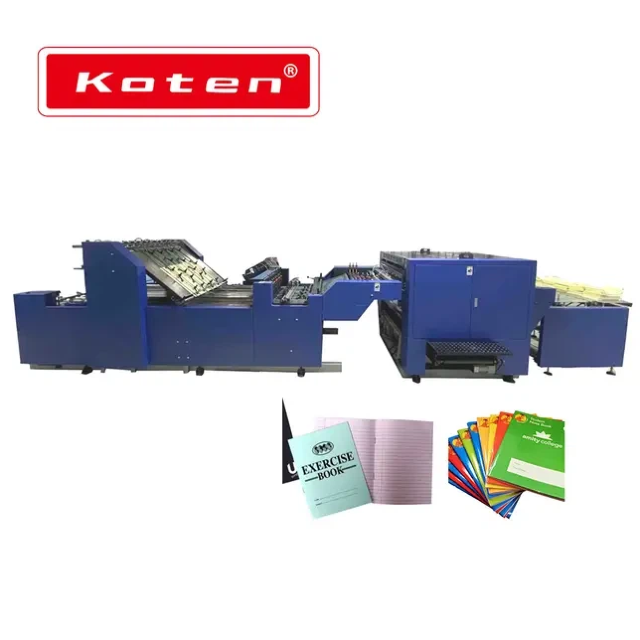
Fully automatic exercise book production lines combine multiple machine modules into a single coordinated system. Paper unwinding, ruling, counting, stitching, folding, trimming, and stacking occur in a continuous workflow.
Because these modules are integrated, materials move seamlessly between stages. Automation reduces manual intervention and allows the production line to operate at high speeds with minimal labor.
This type of system is particularly suitable for factories producing large volumes of standardized exercise books.
Semi automatic setups organize the same production steps using separate machines rather than one continuous line. Each machine performs a specific operation such as ruling, gathering, stitching, or trimming.
Operators transfer materials between machines, giving the workshop more flexibility in scheduling and product variation. Semi automatic systems are often used by manufacturers that produce smaller batches or a wider variety of notebook formats.
The choice between automatic and semi automatic configurations affects both labor requirements and production flexibility. Automated lines reduce manual handling and support higher production capacity, while semi automatic workshops allow greater adaptability for different notebook specifications.
Understanding these structural differences helps manufacturers choose the configuration that best matches their production strategy.
Different notebook formats require adjustments in machine configuration. Larger exercise books or higher page counts may require stronger stitching systems or different folding mechanisms.
Matching equipment components with product specifications ensures that the production line operates efficiently and maintains consistent quality.
Manufacturers must also consider expected production volume. High-volume factories benefit from integrated systems that operate continuously, while smaller operations may prioritize equipment that allows faster changeovers between product types.
Production planning helps determine which machine components will deliver the best balance between speed and flexibility.
Every factory operates with different priorities. Some focus on large-scale standardized production, while others supply diverse notebook formats to multiple markets.
Selecting the right combination of machine modules ensures that the production solution supports the factory’s real operational goals.
Before requesting equipment quotations, manufacturers should define the materials they intend to use. Paper thickness, cover weight, and stitching wire specifications all influence machine configuration.
Providing accurate material information helps equipment suppliers recommend appropriate system designs.
Exercise book size, page count, and binding style are equally important. Clear product specifications allow engineers to determine the correct machine setup for the desired output.
This preparation ensures that the proposed production line matches the manufacturer’s actual product plan.
Finally, manufacturers should consider the entire workflow from raw paper input to finished book packaging. Defining this workflow helps identify whether a fully integrated line or a semi automatic setup is more suitable.
Part of the Solution | Material or Machine Section | Main Function | Effect on Finished Book |
Writing paper | Raw material | Forms notebook pages | Determines writing quality |
Cover stock | Raw material | Protects pages and carries design | Enhances durability and appearance |
Feeding system | Machine module | Introduces paper into production | Ensures stable workflow |
Stitching and folding section | Machine module | Binds and forms the notebook | Provides strong spine structure |
Trimming and stacking | Finishing module | Cuts and organizes finished books | Creates clean, market-ready products |
Understanding what makes up an exercise book production system reveals that it is far more than a single piece of equipment. Materials, machine modules, and coordinated workflow stages must all function together to transform paper into finished notebooks efficiently. A well-designed production system aligns these components into a seamless process that supports both productivity and quality. When manufacturers plan carefully and select equipment that matches their product requirements, notebook manufacturing solutions become a reliable foundation for consistent and scalable exercise book production.
Koten Machinery has specialized in printing and packaging machinery manufacturing since 2005, providing integrated solutions for book production, post-press processing, and paper converting equipment. Our exercise book production systems combine reliable machinery design with efficient workflow planning to support notebook manufacturers worldwide.
If you are planning to establish or upgrade your exercise book manufacturing capacity, contact Koten Machinery to learn more about our complete exercise book production solutions and how they can support your production goals.
The main materials include writing paper for inner pages, cover stock for protection and branding, and metal wire used for stitching the folded sheets together.
Typical systems include feeding units, ruling or printing machines, counting and gathering equipment, stitching and folding machines, and trimming and stacking modules.
Wire stitching provides a strong, economical binding method that supports high-speed production while keeping the notebook structure durable and easy to open.
Yes, many systems can be adjusted to produce various notebook sizes and page counts, allowing manufacturers to serve multiple markets with the same production infrastructure.


