
Views: 0 Author: Site Editor Publish Time: 2026-09-19 Origin: Site
Commercial printers face intense operational strain when balancing high-volume throughput with the precise registration required for thread-sewn book blocks. High-durability, lay-flat products like art books, premium catalogs, and heavy-duty textbooks demand flawless execution on the bindery floor. Legacy bindery equipment often fails under these modern production demands, causing frequent jams, inconsistent thread tension, and severe bottlenecks. Upgrading to modern Central Sewing Book Solutions requires moving beyond basic specification sheets. You must evaluate mechanical precision, automation capabilities, and workflow integration. A strategic equipment upgrade directly addresses these bottlenecks, ensuring your bindery handles complex stocks and rapid turnarounds without sacrificing structural integrity. Evaluating these systems properly means looking closely at how they feed, stitch, and integrate into your broader production floor.
Automation is the Baseline: Modern facilities require automated signature feeding, automated needle positioning, and digital job setups to minimize changeover times and reduce dependency on highly specialized operators.
Format Flexibility Drives ROI: The ability to seamlessly switch between varied signature sizes, paper weights, and stitch configurations dictates the true utilization rate of the equipment.
Integration Over Isolation: Standalone machines are being phased out in favor of systems that integrate directly with existing folding and gathering lines.
Vendor Support is a Feature: Long-term operational success relies heavily on preventative maintenance schedules, parts availability, and technical support infrastructure.
Manufacturers advertise peak mechanical speeds in signatures per minute (SPM). Raw speed does not equal daily shift output. A machine rated for 200 SPM rarely runs at that speed continuously. You must calculate expected daily shift outputs by factoring in realistic operational interruptions. Contrast peak mechanical speed with actual operational speed. Real-world throughput accounts for loading hoppers, unloading finished book blocks, and thread-spool changeovers. If a machine runs fast but requires the operator to stop the line every twenty minutes to clear a minor jam, net throughput drops significantly. Establish a baseline reflecting your average job length. Short-run jobs demand rapid changeovers. Long-run jobs benefit from high SPM and large-capacity hoppers.
To accurately project your actual daily throughput, follow these calculation steps on the bindery floor:
Record the total available shift minutes minus scheduled breaks and maintenance windows.
Subtract average daily setup times based on your typical number of job changeovers.
Deduct estimated downtime for thread spool replacements and routine jam clearances.
Multiply the remaining productive minutes by the machine's realistic running speed, not the maximum rated SPM.
Binderies utilize Smyth sewing to achieve superior structural integrity and a true lay-flat open. This process sews through the fold of individual signatures, linking them into a cohesive book block. The equipment must maintain consistent thread tension across varying spine thicknesses. If tension is too tight, the spine swells, causing severe issues during casing-in. If tension is too loose, the book block lacks stability. You must identify acceptable tolerances for needle penetration and signature alignment. Precision is non-negotiable. Needles must strike the exact center of the fold. Misaligned strikes create enlarged holes or tear the paper. This allows glue to seep into inner pages during perfect binding or spine-gluing stages. Glue seepage ruins the lay-flat effect and results in rejected products.
| Quality Metric | Acceptable Standard | Consequence of Failure |
|---|---|---|
| Needle Penetration | Dead-center of the signature fold. | Enlarged holes, torn paper, and glue seepage during casing-in. |
| Thread Tension | Firm but yielding; consistent across all signatures. | Spine swelling (too tight) or wobbly, unstable book blocks (too loose). |
| Signature Alignment | Perfectly flush head and foot registration. | Uneven trims, compromised structural integrity, and rejected final products. |
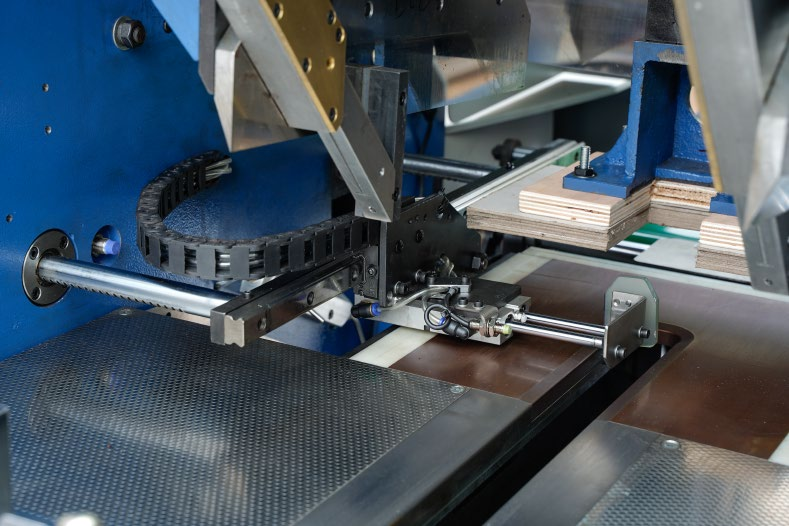
The feeding mechanism dictates the pace of the entire sewing operation. If signatures fail to feed reliably, stitching heads sit idle. Examine the reliability of hybrid or dual-feed systems. The most effective systems combine vacuum suction cups with mechanical grippers. This dual approach handles complex, mixed-stock jobs without jamming. Suction separates the bottom signature from the pile. Grippers physically pull it onto the saddle. This proves necessary when alternating between coated art papers, uncoated offsets, and lightweight stocks within the same shift.
Automated registration systems monitor the feed continuously. Modern machines utilize optical sensors and camera recognition. Cameras read barcodes or printed image marks on the spine of each signature. They detect misfeeds, missing signatures, or incorrect sequencing before the needle strikes the paper. If signature four attempts to feed after signature two, the machine instantly halts. Assess the ability to selectively disengage specific feed mechanisms. Some jobs involve delicate, non-standard, or oversized signatures. Aggressive mechanical grippers might damage these. The operator needs the ability to turn off certain grippers or adjust vacuum pressure on the fly.
High-speed sewing generates significant kinetic energy. Analyze the engineering of sewing saddles and stitching heads for vibration reduction. Machines built with heavy cast-iron frames absorb vibration better than lighter aluminum counterparts. Reduced vibration ensures needles remain perfectly aligned during high-speed runs. When the stitching head vibrates, needle deflection occurs. This leads to broken needles and torn signatures. Active thread tension monitoring systems prevent thread breakage and ensure tight, uniform blocks. These systems automatically adjust tension based on signature thickness and machine speed. If a thread breaks, the monitoring system immediately stops the machine and alerts the operator.
Evaluate programmable stitch length and spacing configurations. A heavy textbook requires a different stitch pattern than a thin catalog. The machine must adapt stitch density to specific structural requirements. Look for automated threading assistance, pneumatic thread cutting, and easy-access thread guides. These features reduce downtime during spool changes. Pneumatic cutters provide a clean sever of the thread at the end of a block. This prevents long tails that tangle in downstream equipment.
Binderies handle a wide variety of trim sizes. Outline the required range for minimum and maximum book block sizes. Focus on both spine length and width. The machine must accommodate smallest pocket-sized books and largest coffee-table art books. Evaluate mechanisms for size changeovers. Legacy machines require manual wrench-and-ruler calibrations. This takes an operator up to an hour to complete. Modern solutions utilize tool-less adjustments and motorized axes. The operator selects a saved job profile from the touchscreen memory. Servomotors automatically move side guides, saddles, and delivery belts into precise position. This reduces changeover times from forty-five minutes to less than five minutes.
When selecting an Automatic Sewing Binding Machine, you must decide between an offline, standalone unit and an in-line system connected directly to a gatherer. Compare the operational footprint and labor requirements of both approaches to determine the best fit for your production floor layout.
| Feature | Standalone Machine | In-Line System Integration |
|---|---|---|
| Footprint | Compact; requires less dedicated floor space. | Large; requires a long, linear footprint for the gatherer and conveyor. |
| Labor Requirements | Requires an operator to manually load signatures into the hopper. | Automated transfer from the gatherer eliminates manual loading. |
| Job Flexibility | High; easy to switch between completely different jobs quickly. | Lower; best suited for long runs of the same format. |
| Throughput Bottlenecks | Limited by the operator's ability to keep the hopper full. | Limited by the slowest component in the entire connected line. |
Detail data handoff requirements for integrating the machine into a centralized print MIS or bindery workflow software. Look for JDF (Job Definition Format) and JMF (Job Messaging Format) compatibility. This connectivity allows the prepress department to send job specifications directly to the sewing machine. It eliminates manual data entry errors. The machine reports production data, such as completed blocks and waste counts, back to the MIS in real-time.
The usability of the Human-Machine Interface (HMI) directly impacts daily production. Assess how intuitively the operator navigates the touchscreen. The interface must make selecting stitch patterns, adjusting feed timing, and managing job queues straightforward. A complicated, text-heavy interface leads to operator frustration and setup errors. Look for graphical interfaces visually representing the book block and machine components.
Diagnostic dashboards provide real-time error reporting. Instead of a generic red light, the screen displays a 3D model of the machine, highlighting the exact sensor that detected a jam. Production analytics help managers track shift efficiency. Predictive maintenance alerts notify operators when a specific belt or bearing nears the end of its lifecycle. You can schedule maintenance before a catastrophic failure occurs.
Analyze physical space requirements before committing to a purchase. Account for more than just machine dimensions. Ensure adequate clearance for operators to move safely. Plan space for material staging, including pallets of unsewn signatures and finished blocks. Leave room to open all safety enclosures during maintenance. Discuss the trade-off between investing in one ultra-high-speed unit versus multiple mid-range units. One massive, high-speed machine offers incredible throughput for long runs but creates a single point of failure. If that machine goes down, your entire sewing operation stops. Investing in two mid-range machines provides redundancy. It allows parallel processing of different formats. You can run a short-run art book on one machine while the other churns out a long-run textbook.
Address the reality of the bindery skills gap. Highly experienced bindery operators are retiring. Replacing them proves difficult. Evaluate how much manual intervention the machine requires for complex jobs. Legacy machines require an operator with an ear for the machine, someone who hears when tension is slightly off. Modern machines rely on sensors and servomotors to maintain quality. Determine the learning curve for new operators to achieve baseline proficiency. Setup, operation, and basic troubleshooting must be easily teachable. Machines with intuitive HMIs and motorized changeovers allow a novice operator to become productive in weeks rather than years. The equipment guides the operator through the setup process step-by-step via the touchscreen.
Review required safety features to ensure compliance with local regulations. Light curtains create an invisible barrier that instantly stops the machine if an operator reaches into a moving part. Emergency stops must be prominently located and easily accessible from multiple points around the machine. Interlocking guards ensure the machine cannot run while access panels are open, maintaining strict CE or OSHA compliance. Consider energy consumption metrics and noise reduction engineering. Industrial sewing machines draw significant power. Look for machines with energy-saving standby modes. Noise reduction keeps decibel levels within safe limits. Enclosed stitching heads and sound-dampening panels protect operator hearing and improve the work environment.
Installing heavy bindery equipment disrupts normal operations. Outline a realistic timeline for site preparation, rigging, installation, and calibration. Do not assume the machine will run at full capacity on day one. Site preparation involves ensuring the floor supports the weight and electrical and pneumatic drops are correctly positioned.
Follow this standard installation timeline to minimize bindery disruptions:
Verify floor load capacity and complete all electrical and pneumatic rough-ins prior to delivery.
Schedule professional riggers to offload and position the main chassis and feeding units.
Allocate three to five days for factory technicians to level the machine, connect modules, and calibrate sensors.
Dedicate a full week to operator training and running live test jobs before shifting full production volume to the new unit.
Propose strategies for routing production during the transition period. You will experience a gap in production capacity. Route urgent jobs to legacy machines if available. Build up a buffer of sewn blocks before taking the old machine offline. Arrange to outsource critical sewing jobs to a partner bindery for a few weeks to ensure you do not miss client deadlines.
Identify the risk of thread jamming or needle breakage when introducing new materials. Different jobs require different threads. Cotton threads behave differently than synthetic polyester threads under high tension. Heavy-coated stocks create more friction against the needle than uncoated paper. This leads to needle overheating or glue-like residue buildup from the paper coating. Recommend a rigorous pre-purchase testing phase. Never buy a machine based solely on a manufacturer's demo using perfectly conditioned paper. Send the manufacturer your actual production files, your most difficult paper stocks, and the exact thread types you use. Demand a live demonstration of the machine processing your worst-case-scenario jobs. This proves the machine handles your specific material mix without constant jamming.
The most effective central sewing book solutions balance mechanical robustness with digital automation to consistently lower your cost-per-book. While raw speed looks impressive on paper, true operational efficiency comes from minimizing downtime, preventing errors, and accelerating job changeovers. Decision-makers must weigh format flexibility, programmable stitch configurations, and automated setups heavier than top mechanical speed, especially if the facility handles diverse, short-to-medium run jobs.
Take the following steps to advance your equipment evaluation:
Audit your current bindery bottlenecks to determine exactly how many hours are lost to manual setups and jam clearances each week.
Compile a physical sample list of your most challenging paper stocks, including lightweight and heavy-coated varieties.
Document your minimum and maximum book block dimensions to establish strict format requirements.
Request a live, data-backed demonstration from equipment manufacturers using your specific signature samples.
A: With rigorous preventative maintenance, industrial units typically operate efficiently for 15 to 20 years. The heavy cast-iron frames and mechanical drives are built for longevity. Digital components, sensors, and touchscreens may require retrofitting or software upgrades around the 7-to-10-year mark to maintain compatibility with modern workflow systems.
A: Motorized adjustments reduce setup times from 30-45 minutes down to 3-5 minutes. The operator selects a job profile, and servomotors automatically position the guides and saddles. This drastically increases machine uptime, making it highly profitable to run multiple short-run jobs in a single shift without losing hours to manual wrench calibrations.
A: Yes, but specialized feeding mechanisms are required. To process stocks below 40 gsm without tearing, the machine must utilize dual-feeding systems combining mechanical grippers with highly adjustable vacuum suction controls. The operator must be able to fine-tune the vacuum pressure to lift the delicate paper gently.
A: Varying the stitch length and spacing allows binderies to optimize the structural integrity of the book block based on paper thickness and final trim size. A denser stitch pattern provides strength for heavy textbooks, while adjusting the spacing prevents excessive spine swelling on books with high page counts.
A: Smyth sewing involves passing thread through the center fold of individual signatures, linking them together. This structural method allows the finished book to lay completely flat when opened. Standard block stitching drives thread or wire through the entire side of the gathered block, which severely restricts how far the book can open.
A: Optical recognition is absolutely critical. Cameras scan barcodes or printed marks on every signature to verify the correct sequence before stitching. This prevents out-of-sequence signatures from being sewn into the block, saving binderies thousands of dollars in ruined products, wasted materials, and lost production time.
A: Industrial sewing machines generally require a dedicated 3-phase electrical connection to handle the high power draw of the main drive motors and servomotors. Additionally, they require dedicated, clean compressed air lines to operate the pneumatic actuators, thread cutters, and vacuum suction feeders reliably.


