Views: 0 Author: Site Editor Publish Time: 2026-11-11 Origin: Site
Manual packaging can quietly increase production costs. As orders grow, labor and film expenses rise. Is automation becoming a better investment? A film wrapping machine can improve packaging speed and consistency. However, its value depends on actual production needs. This guide explores ROI, labor savings, and operating costs. You will learn when automation pays off.
A film wrapping machine becomes worthwhile when manual packaging limits production. It can also make sense when labor expenses continue rising. The key is whether measurable savings justify the investment.
Manufacturers should examine their daily packaging operations first. They need to identify repeated tasks and production delays. These factors reveal where automation can create business value.
Manual wrapping requires repeated handling and operator attention. Workers must position products and apply film. They also need to control wrapping tension.
As order volumes increase, these tasks consume more time. Packaging may become slower than the upstream production process. Finished products can then accumulate before shipment.
An automatic film wrapping machine can reduce this bottleneck. It provides more controlled wrapping operations. The actual output depends on product dimensions and machine configuration.
Labor expenses are a major part of manual packaging costs. Some factories assign several workers to wrapping operations. Their responsibilities include positioning, wrapping, and finished-product handling.
Automation can reduce repetitive manual work. Operators can supervise equipment instead of wrapping every product. This may allow factories to reorganize their workforce.
However, labor savings depend on the production layout. Some machines still require manual feeding or product positioning. Buyers should compare staffing requirements before and after installation.
Frequent orders create a stronger case for automation. Regular production helps maintain consistent machine utilization. It also makes annual operating costs easier to estimate.
Occasional packaging demand may not justify expensive equipment. A machine could remain unused for long periods. Its purchase cost would then be harder to recover.
Factories handling daily orders have different investment conditions. They can spread equipment costs across more packages. Stable workloads also support more reliable financial forecasts.
Manual wrapping quality can vary between operators. Film tension and overlap may change during each shift. Loose wrapping can reduce package stability.
Excessive wrapping creates another problem. It increases film consumption without necessarily improving protection. Inconsistent application can also affect product appearance.
Automated settings help standardize wrapping conditions. They can control film application more consistently. This is valuable when packaging specifications remain stable.
Film expenses can become significant across large production volumes. Manual operators may use different wrapping patterns. Their film usage can vary between packages.
Controlled wrapping helps manufacturers standardize material application. Film tension and wrapping layers can be adjusted. The target is adequate protection without unnecessary material use.
Factories should measure film consumption per package. Compare the results before and after automation. Actual tests are more reliable than estimated savings.
Older equipment may restrict production capacity. Manual handling can also slow down connected production lines. These problems become more serious as orders grow.
An automated wrapping system can improve downstream packaging flow. It may connect to conveyors and other equipment. This helps reduce unnecessary product transfers.
Manufacturers should evaluate the entire packaging process. A faster wrapping machine cannot solve every production bottleneck. Upstream capacity must support its operating speed.
Business condition | Manual wrapping | Automated wrapping |
|---|---|---|
High daily output | More labor required | Better continuous processing |
Labor availability | Greater worker dependence | Less repetitive handling |
Wrapping quality | Operator-dependent | More controlled settings |
Frequent orders | Repeated manual work | More predictable processing |
Production expansion | Additional workers may be needed | Greater automation potential |
Tip: Record packaging delays, labor hours, and film usage before requesting equipment quotations. These figures establish a useful investment baseline.
A machine's purchase price represents only part of its investment. Installation and operating expenses also affect profitability. Buyers should calculate the total ownership cost.
A complete cost assessment helps prevent unrealistic expectations. It also makes different equipment quotations easier to compare. Consider the following expenses before purchasing.
The initial investment includes the machine itself. Different configurations have different purchase requirements. Semi-automatic and fully automatic systems are not priced equally.
Installation can create additional expenses. These may include electrical work and conveyor connections. Commissioning and operator training should also be considered.
Factories should request a complete quotation. Check whether transportation and installation are included. Also confirm the scope of technical support.
Film consumption directly affects packaging expenses. Film thickness and width influence material requirements. Product dimensions also determine the required wrapping area.
Different wrapping methods use different materials. Shrink systems commonly use PE or POF films. Stretch systems generally use elastic stretch film.
The number of wrapping layers also matters. Excessive layers increase material costs. Insufficient coverage may reduce package protection.
Machine operation still requires trained personnel. Their responsibilities depend on automation level. They may load products, monitor settings, and inspect packages.
Electricity is another important operating expense. Shrink wrapping also requires energy for heating. Stretch wrapping usually has different energy requirements.
Compressed air may be necessary for certain configurations. Maintenance supplies and replacement components add further costs. Include these expenses in the annual operating budget.
Every machine requires regular inspection. Components may need cleaning, adjustment, or replacement. Preventive maintenance helps maintain stable production.
Unexpected breakdowns can interrupt packaging operations. They may also delay customer deliveries. Lost production time should therefore be included in cost analysis.
Buyers should check spare parts availability. Ask about warranty coverage and technical support. Clear service arrangements help reduce long-term operating risks.
Note: Compare total ownership costs rather than purchase prices alone. Include installation, energy, labor, film, and maintenance.
The payback period shows how long investment recovery may take. It compares the initial equipment cost against annual net savings. This gives buyers a practical financial reference.
However, accurate calculations require reliable factory data. Estimated savings should not replace actual operating records. A realistic calculation should include both savings and additional expenses.
Start by identifying workers assigned to wrapping. Record their working hours and annual wages. Include overtime and related labor expenses.
Next, measure current film consumption. Calculate the average material cost per package. Record rejected packages and wrapping-related production delays.
These figures establish the existing packaging cost. They also provide a baseline for comparison. Use several production periods when demand changes seasonally.
Estimate the labor costs after installation. Consider how many workers remain necessary. Include operators responsible for feeding and inspection.
Next, estimate potential film savings. Compare material consumption during sample production. Use the same product specifications for both tests.
Additional output may create further business value. However, increased capacity only matters when customers need the products. Do not count unused production capacity as guaranteed revenue.
The basic calculation is straightforward:
\[ \text{Payback Period}= \frac{\text{Initial Investment}}{\text{Annual Net Savings}} \]
Annual net savings equal annual cost reductions minus additional operating expenses. These expenses include electricity and maintenance. They may also include additional staffing costs.
Consider this hypothetical investment example:
Item | Illustrative value |
|---|---|
Machine investment | $30,000 |
Annual labor savings | $12,000 |
Annual material savings | $4,000 |
Additional annual operating costs | $2,000 |
Annual net savings | $14,000 |
Estimated payback period | 2.14 years |
The example assumes stable production throughout the year. Actual results will depend on factory conditions. Buyers should verify every financial input before investing.
Low machine utilization can extend the payback period. Seasonal orders may leave equipment idle. Unstable production demand creates additional financial risk.
Maintenance expenses can also reduce annual savings. Unexpected downtime may increase labor and delivery costs. Incorrect machine selection can create further problems.
Manufacturers should prepare conservative financial forecasts. Compare expected and worst-case production scenarios. This makes investment decisions more reliable.
Tip: Calculate ROI using accepted finished packages, not theoretical machine capacity. This prevents overstating the financial benefits of automation.
Different wrapping machines serve different packaging requirements. Their investment value depends on product type and production volume. Buyers should understand these differences before selecting equipment.
The main options include semi-automatic and fully automatic systems. Shrink film and stretch film also require different processes. These categories should not be confused.
A semi-automatic film wrapping machine combines mechanical operations with manual handling. Operators position products or start individual wrapping cycles. The machine then performs its configured wrapping tasks.
This arrangement can suit small and medium production volumes. It reduces some repetitive work without requiring complete automation. Its initial investment may also be lower.
Goodpacking's referenced sleeve sealing system illustrates this approach. Its GH-6030 and SF-6040E configuration uses PE shrink film. The listing describes a sealing unit and separate shrink tunnel.
A fully automatic film wrapping machine reduces manual intervention. Depending on its configuration, it can handle feeding, wrapping, and discharge. Conveyor integration can support continuous packaging.
These systems generally suit larger production requirements. They can reduce repetitive handling across multiple operations. However, their initial investment may be higher.
Huadong's automatic shrink equipment illustrates integrated sealing and heating configurations. Published models include PLC controls and adjustable conveyor speeds. Actual capacity depends on the selected model and product specifications.
Shrink wrapping uses heat to contract film around products. The process generally includes film feeding and sealing. Products then pass through a heated tunnel.
This method suits beverage multipacks and consumer goods. It can also package cartons and selected industrial products. Film selection depends on product requirements and machine design.
PE and POF are common shrink film options. Heating temperature and conveyor speed affect the result. Energy consumption should be included in ROI calculations.
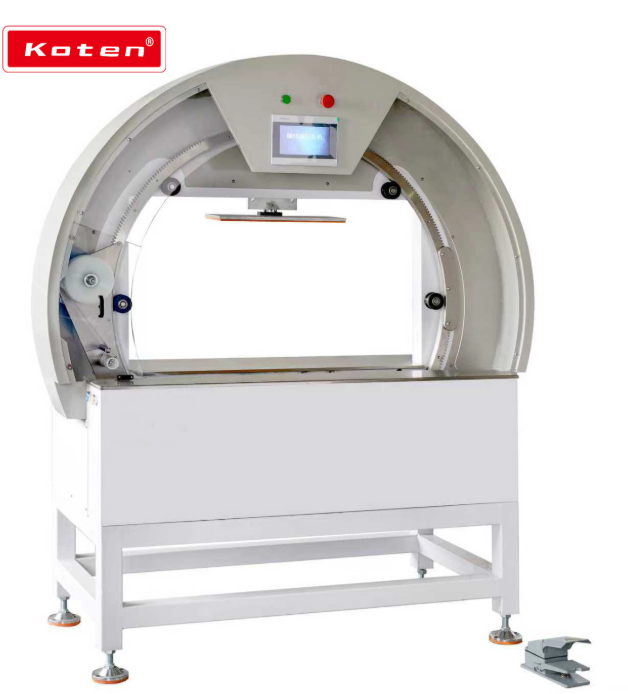
Koten provides film wrapping machine solutions for packaging applications. Buyers can review the available equipment range. They should confirm compatible film types and product dimensions.
Stretch wrapping uses elastic film tension to secure products. The film stretches around the product during application. It then helps hold the package together.
Ring-type machines suit long products and profiles. Their film carriage rotates around products during conveying. This differs from shrink wrapping through a heating tunnel.
Fengyue's referenced equipment illustrates ring-type stretch wrapping. It targets long-product packaging applications. Such systems may suit profiles and elongated industrial materials.
Made-in-China.com+1
Machine configuration | Main process | Typical application |
|---|---|---|
Semi-automatic shrink wrapper | Manual positioning, sealing, heating | Smaller packaging workloads |
Automatic shrink wrapper | Automatic feeding, sealing, shrinking | Beverage and consumer products |
Ring-type stretch wrapper | Rotating film application | Profiles and long materials |
Pallet stretch wrapper | Film tension around pallet loads | Warehousing and logistics |
Note: Shrink and stretch systems are not interchangeable. Select the process according to product shape, protection needs, and packaging material.
Film wrapping automation supports several manufacturing sectors. Its value depends on packaging frequency and product characteristics. Different industries also require different equipment configurations.
Factories should identify their main packaging applications. They should then compare equipment performance against actual production needs.
Beverage producers often package bottles and cans in multipacks. Shrink film helps hold products together. It also provides a consistent outer package.
Food manufacturers use film for selected product bundles. Regular orders can create predictable machine workloads. This helps improve equipment utilization.
A suitable automatic shrink system can support continuous packaging. Buyers should check product dimensions and required pack arrangements. Heating performance and film compatibility also matter.
Industrial manufacturers package pipes and profiles for transportation. These products may require protection against dust and surface damage. Long dimensions also create special wrapping challenges.
Ring-type stretch wrappers address these requirements. Their rotating film carriage wraps products during conveying. Adjustable tension and wrapping layers influence coverage.
Koten's fully automatic PE wrapping film packaging machine provides another equipment option to evaluate. Buyers should confirm its intended product range. They should also verify film compatibility and production capacity.
Warehouses often wrap palletized goods before shipment. Stretch film helps stabilize stacked products. It can reduce movement during handling and transportation.
High shipping volumes may justify automatic wrapping. Regular pallet sizes support repeatable machine settings. This can reduce repetitive manual work.
However, load stability depends on several factors. Pallet condition and product arrangement remain important. Film tension and wrapping patterns must suit the load.
Tip: Test representative products before purchasing equipment. Check package stability, film consumption, and actual cycle time.
Before purchasing equipment, manufacturers should review their current packaging operations. The decision should reflect actual production demand. It should also consider future business plans.
A structured assessment helps identify the right automation level. It prevents unnecessary investment in oversized equipment. It also reduces the risk of insufficient capacity.
Calculate the average number of packages per shift. Record both normal and peak production volumes. Identify seasonal changes in customer demand.
Compare these figures against machine capacity. Consider actual operating speed and product changeovers. Allow time for loading and routine adjustments.
A machine should match realistic production requirements. Excess capacity can increase investment costs. Insufficient capacity may create another bottleneck.
Record current labor expenses and working hours. Measure film consumption for representative products. Include overtime and rejected packaging.
Next, estimate the additional operating costs. Consider electricity, maintenance, and operator training. Include installation and integration expenses.
Compare the annual costs under both production methods. Use the same packaging volume for each calculation. This provides a fair financial comparison.
Start by identifying product dimensions and shapes. Determine whether products need shrink or stretch wrapping. Their packaging requirements are different.
Check film thickness, width, and material compatibility. Confirm the machine supports the required wrapping pattern. Product samples can help verify performance.
Also consider the required protection level. Some products need close-fitting shrink packaging. Others need stretch film for transportation stability.
Review available factory space and conveyor arrangements. Confirm electrical supply and compressed air requirements. Check access for installation and maintenance.
Consider whether the machine can connect to existing equipment. Production line compatibility affects overall efficiency. Poor integration can create unexpected handling delays.
Future demand also deserves attention. A flexible configuration may support additional product sizes. Buyers should discuss customization before finalizing specifications.
Tip: Prepare a product specification sheet before requesting quotations. Include dimensions, film type, daily output, and packaging samples.
A film wrapping machine becomes worthwhile when labor savings, material control, and higher output justify its investment. The right configuration also improves packaging consistency and production efficiency.
Ruian Koten Machinery Co., Ltd. provides film wrapping machine solutions for different production needs. Its equipment helps manufacturers improve packaging operations and support long-term production growth.
A: When labor and material savings justify its investment.
A: Divide initial investment by annual net savings.
A: Automatic suits high volumes; semi-automatic suits smaller orders.
A: Controlled film use can reduce waste and labor expenses.


