Views: 0 Author: Site Editor Publish Time: 2026-08-18 Origin: Site
Right-angle fold registration drift remains a persistent challenge in commercial print finishing operations. This subtle defect frequently leads to unacceptable waste, rejected jobs, and severe production bottlenecks on the shop floor. Operators desperately need robust solutions to handle complex substrates, heavy stocks, and large formats without constant tweaking. The Combination Paper Folding Machine serves as a specific engineering answer to these rigorous demands. It integrates distinct folding methods to tame stubborn materials and deliver perfectly aligned signatures. In this article, we evaluate the precise mechanical and electronic controls these folders use to maintain strict cross-fold tolerances. You will discover how specific components manage paper transition, tension, and alignment. Ultimately, this breakdown will help you make an evidence-based equipment decision for your finishing department.
Commercial print finishing sets strict standards for acceptable tolerance. Usually, this window sits firmly within plus or minus 0.5 millimeters. A mere 1mm skew during the initial parallel fold might look harmless on the delivery belt. However, this microscopic error compounds rapidly. By the time the paper reaches the final right-angle section, that tiny deviation transforms into a severe defect. Text blocks shift off-center. Crucial binding margins disappear. The entire signature ultimately becomes unusable, forcing you into expensive reprints.
Substrate variables constantly fight against clean folding mechanics. Three primary material factors dictate your success rate:
A reliable finishing solution must overcome these inherent material challenges. It must deliver consistent accuracy across thousands of cycles. Relying on constant manual operator intervention simply drains your profit margins. You need equipment engineered to conquer these variables systematically.
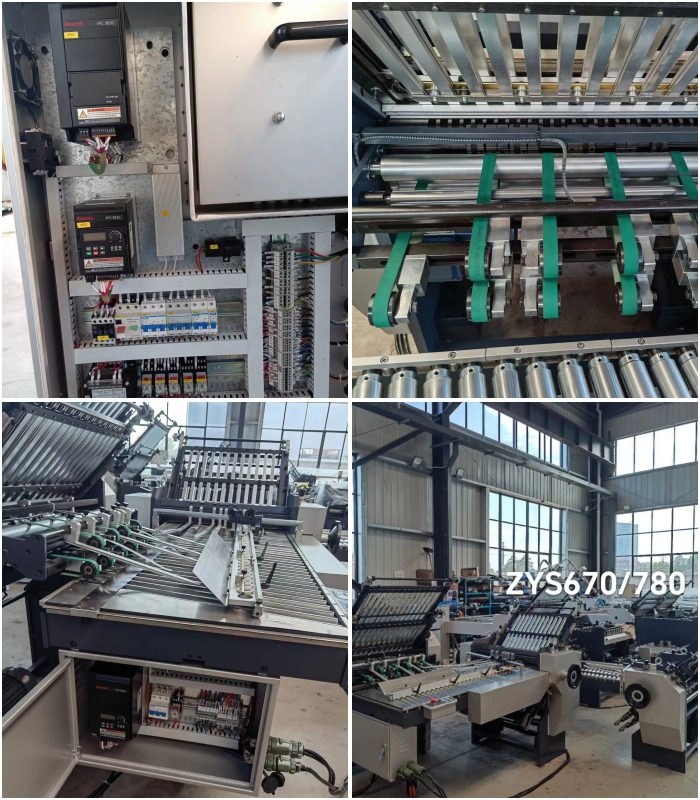
The hybrid architecture defines this equipment category. It cleverly blends two distinct folding mechanisms into one continuous production sequence. First, the unit utilizes parallel buckle plates to execute the initial parallel folds. Following this section, an integrated electronic knife takes over to drive the heavier cross folds.
Standard Paper Folding Machines generally rely entirely on buckle plates for every fold direction. This pure friction-based approach works beautifully for lightweight stocks. However, pure buckle systems often fail when executing right-angle folds on heavy cover stocks. The paper resists buckling into the rollers. The combination model solves this physical limitation. It reserves the sheer mechanical downward force of a heavy knife for those stubborn perpendicular folds.
The most critical engineering zone resides at the handoff. Here, the machine moves the partially folded sheet from the parallel delivery section directly onto the cross-carrier belt. The sheet must travel at high velocity, then decelerate rapidly, and stop against a side lay. It must achieve this stop-and-go transition without bouncing back or losing its square alignment. Advanced hybrid units deploy specialized suction belts, ball-bearing guides, and tension springs to maintain absolute control during this volatile transfer period.
Precision engineering directly dictates how well a unit holds its cross-fold tolerances over a long shift. Several discrete components directly impact your production outcomes. We must evaluate them based on their mechanical function and final accuracy results.
Evaluating Cross Fold Control Components
| Technology Component | Mechanical Function | Accuracy Outcome |
|---|---|---|
| Skewed Roller Table | Drives sheet diagonally against the side guide. | Ensures exact 90-degree alignment prior to knife drop. |
| Rotary Scoring Unit | Physically crushes and breaks paper grain fibers. | Prevents spine cracking and ensures a clean crease. |
| Optical Sensors & Servos | Detects leading edge to trigger instantaneous knife actuation. | Matches fold timing perfectly to variable sheet speeds. |
| Polyurethane Segments | Modulates the precise grip-to-slip friction ratio. | Prevents the thick signature from twisting during the fold. |
Cross-carrier and registration tables provide the baseline for success. Skewed rollers drive the incoming sheet aggressively against a rigid side guide. This action forces a perfect 90-degree alignment before the knife ever strikes. If the sheet floats away from this guide, your cross fold will inevitably skew.
Pre-slitting and scoring play an equally vital role. You must deploy rotary scoring tools on the parallel fold exit shafts. Scoring physically breaks the internal paper grain. This preparatory step ensures the subsequent knife fold remains clean, accurate, and completely free of ugly cracking.
Electronic knife timing represents a massive leap forward. Older equipment used mechanical cams and clutches, which suffered from severe wear and timing lag. Today, we rely exclusively on servo-driven electronic knives. High-speed optical sensors read the exact leading edge of every passing sheet. They trigger precise servo motor actuation, matching the knife drop to the exact microsecond the sheet arrives in position.
Finally, evaluate the polyurethane and steel roller configurations. The grip-to-slip ratio prevents catastrophic jams. Fold rollers use alternating polyurethane and steel segments. Operators must apply precise caliper settings, adjusting the roller gap by inserting a strip of the exact job stock. This physical gap calibration prevents the sheet from twisting during the violent downward motion of the knife.
Evaluating equipment types requires looking closely at your daily production realities. You must align the structural architecture with your most common jobs. A skeptical, objective comparison helps clarify this decision.
There are distinct scenarios where a pure Buckle Paper Folding Machine proves mechanically superior. If your print shop primarily handles highly complex parallel folds, buckle machines offer unmatched flexibility. They allow you to stack four, six, or eight plates in a single station. They also excel with very light stocks, pharmaceutical inserts, and dense multi-panel accordion folds. The gentle friction-based buckle process handles these fragile weights brilliantly.
Conversely, combination architecture dominates in heavy signature work. If you frequently produce 8-page, 16-page, or 32-page book signatures, a hybrid unit remains your best choice. It handles heavy text and cover-weight stocks without hesitation. The knife forces the fold exactly where you need it, regardless of paper stiffness. Furthermore, this design allows the machine to operate in a much smaller physical footprint. It avoids the sprawling right-angle plate stations required by pure buckle systems.
We must acknowledge certain transparent assumptions regarding setup routines. Traditionally, combination folders required slightly longer setup times for the knife section. Setting the exact roller pressure, side lay micro-adjustments, and knife drop height takes genuine operator finesse. However, modern automated machines are rapidly closing this historical gap. Advanced units now store knife depth and automated roller gap settings within a central digital memory bank, dramatically reducing make-ready times.
Pushing equipment to its maximum output always introduces new implementation realities and risks. There is an undeniable inverse relationship between processing speed and mechanical accuracy. You must manage physical forces carefully as production velocity increases.
Running a High Speed Paper Folding Machine generates massive amounts of static electricity. Friction builds up rapidly as paper flies through the initial parallel buckle plates. This electrostatic charge causes sheets to float, stick together, or bounce when they finally hit the cross-carrier belts. A side guide simply cannot register a floating sheet accurately. Therefore, you must evaluate integrated anti-static bars and localized ionizers as necessary, non-negotiable features. They neutralize the charge before the sheet reaches the knife.
Despite advancements in touch-screen automation, maintaining right-angle accuracy still requires strong operator expertise. Operators must intimately understand how mechanical roller pressures interact with specific paper grain directions. They must know exactly when to increase pre-scoring depth on heavily coated stocks. To mitigate shop-floor skill gaps, evaluate the equipment's software capabilities thoroughly. Look for robust job memory systems and automated caliper setup features. These tools help less experienced staff recall the perfect pressure calibrations from previous successful runs, reducing reliance on tribal knowledge.
Securing exact cross fold accuracy requires a systematic approach to sheet control, not operator guesswork. Perfect alignment relies heavily on pre-conditioning the paper grain before the electronic knife initiates the fold. Modern optical sensors and servo motors remove mechanical lag from high-velocity sheet timing, ensuring repeatable precision.
As a next step, advise your purchasing team to request a live equipment demonstration. Bring your own standard and worst-case paper stocks. Pay specific attention to the actual setup time required for cross-fold calibration. Track the exact amount of waste generated before the machine achieves a perfectly square, sellable signature.
A: Grain running parallel to the cross fold is ideal. Perpendicular grain causes resistance and cracking, requiring deep pre-scoring before the knife fold.
A: Yes, but it requires careful tension reduction and anti-static control, as lightweight sheets can buckle prematurely when hitting the cross-section side guide.
A: Regular cleaning of optical sensors, checking knife edge wear, and calibrating the servo-motor timing. Worn polyurethane rollers are the #1 cause of sudden registration drift.