Views: 0 Author: Site Editor Publish Time: 2025-11-19 Origin: Site
Paper cutting is a fundamental process in offices, printing houses, packaging facilities, and craft projects. Whether producing professional documents, packaging materials, or creative craft items, precise and efficient paper cutting is essential to ensure clean edges, consistent sizes, and professional-quality results.
Businesses and hobbyists alike rely on specialized paper cutting tools to save time, reduce waste, and achieve accurate results. However, not all cutting tools are the same. Choosing the right type of paper cutter depends on factors like production volume, material thickness, and required precision.
This raises the question: “What are the three main types of paper cutting, and which applications are they best suited for?” Understanding these three types helps users select the most suitable equipment for their needs, whether it’s for small-scale crafts, medium-scale office tasks, or high-volume industrial production.
Paper trimmers are versatile and compact cutting tools specifically designed to provide precise, straight cuts on single sheets or small stacks of paper. They are widely used for light-duty cutting tasks where accuracy and convenience are priorities. Paper trimmers can be either manual, requiring the operator to guide the blade along a fixed edge, or semi-automatic, which may include spring-assisted or guided mechanisms for smoother and faster cutting. These tools are ideal for situations where space is limited and ease of operation is essential.
Home Offices & Educational Settings: Perfect for preparing reports, assignments, documents, or student projects with clean, straight edges.
Craft Projects & DIY Activities: Essential for scrapbooking, card-making, invitations, or other creative projects that demand precision and neat finishes.
Light-Duty Cutting Tasks: Suitable for small batches of paper, flyers, or promotional materials where high-volume speed is less critical than accuracy.
Compact & Space-Saving: Their small footprint makes paper trimmers easy to store and operate even in confined workspaces.
User-Friendly: Designed for intuitive use, they are accessible to beginners, hobbyists, and office personnel without extensive training.
Safe Operation: Many models feature protective blade guards or locking mechanisms to minimize risk of injury during use.
Low Maintenance: Minimal upkeep is required, making them a cost-effective solution for home, school, or light commercial use.
Limited Stack Cutting: Paper trimmers are generally suitable for only a few sheets at a time, making them less effective for bulk or high-volume cutting jobs.
Slower for High-Volume Tasks: Efficiency drops considerably when large quantities of paper need to be trimmed quickly.
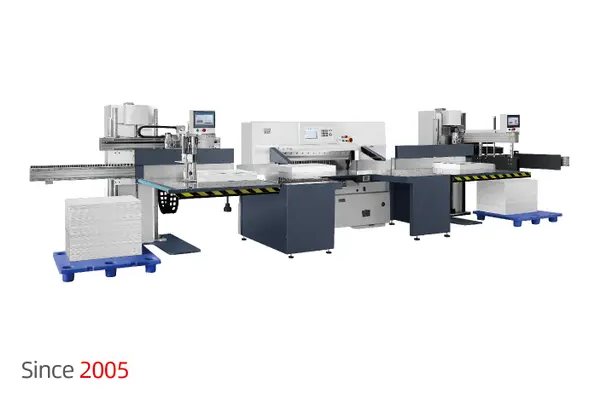
Guillotine paper cutters are heavy-duty cutting machines designed to trim large stacks of paper with high precision and efficiency. They typically feature a long, sharp blade mounted on a lever, mechanical arm, or hydraulic system, allowing operators to cut multiple sheets at once. Guillotine cutters are engineered for professional and industrial use, ensuring clean, straight cuts across thick or laminated sheets. Their robust construction and precise blade mechanism make them suitable for demanding cutting tasks in high-volume environments.
High-Volume Office Cutting: Ideal for trimming large stacks of documents, reports, or forms in corporate offices or administrative settings.
Commercial Printing Operations: Essential for printing houses and publishing companies to cut books, magazines, brochures, and other printed materials efficiently.
Packaging Industry: Used for cutting cardboard, laminated sheets, or specialty paper materials in packaging production, ensuring uniformity and high-quality finishes.
Precision Projects: Ensures accuracy for thick or multi-layered paper stacks where consistency is critical.
High-Volume Capability: Can handle dozens to hundreds of sheets simultaneously, significantly improving productivity for large-scale operations.
Fast and Precise: Mechanical or hydraulic operation allows repeatable, accurate cuts, reducing errors and minimizing material waste.
Durable and Long-Lasting: Built to withstand continuous industrial use, providing reliable performance over many years.
Versatile Cutting Options: Suitable for a variety of paper types, including laminated sheets, cardboard, and specialty printing materials.
Larger Footprint Required: Guillotine cutters need considerable workspace, making them less suitable for small offices or compact areas.
Safety Considerations: Sharp blades and heavy mechanisms require trained operators and strict safety measures during operation.
Higher Investment: Initial cost and ongoing maintenance are greater compared to small paper trimmers, making them a larger upfront investment.
Rotary paper cutters are specialized machines designed for high-speed, continuous cutting of roll-fed paper. They use rotating cylindrical blades or rollers that slice through paper as it passes through the machine, allowing for precise, uniform cuts on large volumes of material. These cutters are ideal for industrial and commercial operations where efficiency, speed, and consistency are critical. Many rotary cutters are integrated with automated feeding and stacking systems, further improving productivity and reducing manual labor.
Large-Scale Production: Perfect for newspapers, magazines, catalogs, and high-volume printing projects.
Industrial Paper Processing: Used in paper mills or commercial printing houses to cut wide rolls of paper into sheets or specific sizes.
Packaging Applications: Suitable for cutting continuous sheets of cardboard, laminated paper, or specialty substrates for packaging production.
High-Volume Office Applications: Ideal for companies needing rapid and consistent cuts for bulk orders or mass mailings.
High-Speed Cutting: Can handle continuous rolls of paper, significantly improving production efficiency.
Consistent and Precise: Rotating blades ensure uniform cuts across large volumes, reducing errors and material waste.
Reduced Manual Labor: Automated feeding and stacking mechanisms decrease the need for operator intervention, allowing staff to focus on other tasks.
Versatile Material Handling: Can process a variety of materials, including standard paper, coated sheets, laminates, and light cardboards.
Higher Initial Investment: Rotary paper cutters require more capital compared to trimmers or guillotine cutters, making them a larger upfront expenditure.
Maintenance Complexity: Moving parts, rotating blades, and automated systems require regular maintenance and occasional repairs to ensure optimal performance.
Space Requirements: These machines are larger and require dedicated workspace for installation and safe operation.
When choosing a paper cutting solution, it’s important to match the cutter type with your production volume, material, and precision requirements. Understanding the strengths and limitations of each type ensures efficiency, quality, and cost-effectiveness.
Best For: Low-volume, precise cutting tasks.
Material Compatibility: Single sheets or small stacks of standard paper, lightweight cardstock.
Applications: Home offices, schools, craft projects, small business document preparation, scrapbooking, greeting cards, or low-volume promotional materials.
Advantages: Compact, safe, easy to use, and cost-effective for small-scale tasks.
Best For: Medium to high-volume cutting where precision and speed are required.
Material Compatibility: Stacks of paper, laminated sheets, cardstock, or cardboard up to medium thickness.
Applications: Professional offices, commercial printing houses, packaging companies, book and magazine cutting, or brochure production.
Advantages: Fast, precise, and durable for repetitive tasks; handles multiple sheets at once.
Considerations: Requires sufficient workspace, operator training, and a higher initial investment.
Best For: High-volume, continuous cutting operations.
Material Compatibility: Roll-fed paper, laminated sheets, light cardboard, or specialty papers.
Applications: Newspapers, magazines, catalogs, packaging production lines, or industrial-scale printing operations.
Advantages: Continuous, automated cutting with consistent precision; reduces manual labor.
Considerations: Larger footprint, higher cost, and maintenance-intensive.
Small Projects & Precision: Paper trimmers are ideal for personal or small-scale professional use.
Bulk Cutting & Medium-Scale Production: Guillotine cutters balance speed, precision, and stack capacity.
Industrial & Continuous Operations: Rotary cutters are optimal for large-scale, automated workflows.
Selecting the right paper cutting machine is essential for maximizing efficiency, reducing waste, and maintaining precise results. Koten Machinery offers a full range of trimmers, guillotines, and rotary cutters tailored to various production needs, helping businesses achieve professional-quality results across industries.
Choosing the right type of paper cutting machine is crucial for achieving precision, efficiency, and consistent results in printing, packaging, and office applications. The three main types—paper trimmers, guillotine cutters, and rotary cutters—each offer unique benefits tailored to different production needs. Paper trimmers are compact, safe, and ideal for small-scale tasks or craft projects, while guillotine cutters provide fast, accurate, and reliable cutting for medium to high-volume operations. Rotary cutters excel in large-scale, continuous production, delivering consistent results for newspapers, magazines, and industrial workflows.
Understanding the capabilities and limitations of each type helps businesses select the most suitable solution based on volume, material, and precision requirements. Investing in the right equipment not only improves productivity and reduces waste but also ensures high-quality finished products. For companies seeking professional, reliable, and high-performance paper cutting solutions, Koten Machinery offers a comprehensive range of machines, including trimmers, guillotines, and rotary cutters. Their equipment is designed to meet diverse operational demands, providing long-lasting performance and precision. Exploring Koten Machinery’s solutions allows manufacturers and businesses to enhance workflow efficiency, maintain consistent quality, and achieve cost-effective, professional-grade results across all paper cutting applications.


