
Views: 0 Author: Site Editor Publish Time: 2026-07-29 Origin: Site
In an Exercise Book Production Line, notebook trim and fold consistency is not decided only by the folding unit or the trimmer. It depends on the full production workflow, including paper feeding, ruling registration, sheeting accuracy, sheet counting and piling, cover feeding, wire stitching, folding, spine squaring, book cutting, trimming and finished book inspection.
A notebook may have a clean surface and correct page count, but if the fold line is off-center or the trimmed edge is uneven, the finished product will still look unprofessional. For school exercise books, stationery notebooks, wholesale orders and export products, consistent trimming and folding are basic quality requirements.
Koten’s Exercise Book Production Line connects reel paper unwinding, flexo ruling, sheeting, counting, cover feeding, stitching, folding, spine flatting, book cutting, trimming and book collection into one workflow for exercise book production.
This article explains which quality checks help keep notebook trim and fold consistent, why upstream processes affect final finishing, and what manufacturers should evaluate before choosing an automatic exercise book production line.
Notebook trim and fold consistency depends on quality checks across the full Exercise Book Production Line, not only the final folding and trimming sections.
Key points include:
Folding and trimming quality starts before the final section.
Stable paper feeding helps support accurate ruling, sheeting and downstream alignment.
Sheeting length should be checked before counting and piling.
Sheet counting and piling affect book thickness and folding stability.
Cover feeding alignment affects the finished notebook appearance.
Wire stitching position should match the spine and fold line.
Folding line accuracy affects book symmetry and edge alignment.
Spine squaring or spine flatting helps improve book flatness.
Trimming accuracy depends on stack stability, blade condition and upstream alignment.
Finished book inspection should check size, fold, spine, cover position, edges and page alignment.
In short, consistent notebook trim and fold quality is a full-line quality control result.
Notebook trim and fold consistency means the finished books in one batch have uniform size, straight folded spines, clean trimmed edges and stable page alignment.
It includes several visible and measurable quality points:
The book folds at the correct center line.
The stitching line aligns with the fold.
The spine looks flat and stable.
The front edge is clean and even.
The head and tail edges are consistent.
The cover aligns with the inner pages.
Pages do not protrude irregularly.
The finished book size stays within the required specification.
Books stack neatly after collection.
A small shift in folding or trimming may become obvious when many notebooks are stacked together. This is why consistent quality control matters in high-volume exercise book manufacturing.
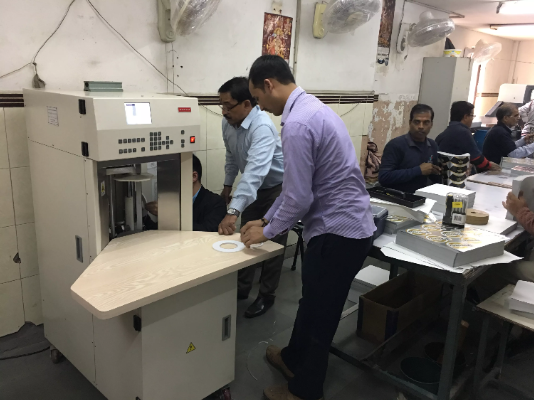
Notebook buyers usually evaluate finished products visually and functionally. If the fold is off-center, the book may not open evenly. If the trimmed edge is rough or uneven, the product looks low quality. If the cover does not align with the inner pages, the notebook may fail inspection.
Poor trim and fold consistency can cause:
Customer complaints
Product rejection
More manual sorting
Rework and waste
Lower production efficiency
Poor stacking during packaging
Unstable finished book appearance
Reduced confidence in repeat orders
For factories producing large quantities, the cost of inconsistent trimming and folding is not only material waste. It also affects delivery time, labor workload and brand reputation.
It is common to blame the folding unit or trimmer when finished notebooks show uneven folds or edges. In reality, many fold and trim problems begin earlier in the production line.
For example:
Poor paper feeding may affect ruling registration and sheet movement.
Inconsistent sheeting length may create size variation before folding.
Incorrect page count may change book block thickness.
Uneven piling may affect how the book block enters stitching.
Cover feeding misalignment may appear as cover overhang after trimming.
Stitching position errors may shift the fold line.
Poor spine squaring may affect book flatness before final trimming.
The trimmer can clean the final edge, but it cannot fully correct upstream problems such as unstable sheeting, wrong page count, poor stitching position or inconsistent folding.
Therefore, quality checks should be arranged across the full line.
Paper feeding is the beginning of the process. Operators should check whether the paper web runs smoothly and whether tension remains stable during production.
Unstable feeding can cause:
Web wandering
Ruling line shift
Sheeting variation
Poor downstream alignment
Increased waste
The goal is not maximum tension. The goal is stable and suitable feeding for the paper GSM, roll width, line speed and book specification.
Ruling lines and margins should stay in the correct position before the paper reaches the sheeting section. If the ruling line is too close to the edge or shifts between sheets, the final book may look inconsistent after trimming.
Operators should check:
Line position
Margin position
Front and back alignment
Ink registration
Visual consistency across sheets
Sheeting accuracy is one of the most important upstream checks for trim consistency. If the cut sheet length varies, the final notebook size may vary even if the folding and trimming sections are properly adjusted.
Operators should confirm:
Cut length
Square cutting
Sheet edge condition
Sheet delivery rhythm
Consistency after speed changes
Sheet counting and piling affect book thickness and stack stability. If the page count is wrong or the pile is uneven, the book block may not fold or trim consistently.
The Automatic Exercise Book Making Machine Model LYRDT-1020 includes sheet counting and piling, wire stitching, folding, spine dressing, front-side trimming, slitting and delivery units, making it relevant for trim and fold consistency control.
The cover should match the inner pages before stitching and folding. If the cover is shifted, the finished book may show overhang, uneven margins or visual misalignment after trimming.
Cover feeding checks should include:
Cover size
Feeding direction
Cover position
Cover-to-inner alignment
Stack stability before stitching
Wire stitching affects the fold line and spine position. If the stitching line is off-center, the folding unit may follow the wrong position, creating an uneven book shape.
Quality checks should confirm:
Stitching distance from spine
Stitching straightness
Wire stability
Alignment with book center
Stitching consistency across samples
The folding line should follow the correct center position and align with the stitching line. Poor folding accuracy may cause one side of the book to become longer than the other, or create a spine that does not close neatly.
Operators should check:
Fold position
Book symmetry
Crease quality
Spine appearance
Opening behavior
Alignment between cover and inner pages
Spine squaring, also called spine flatting in some production contexts, helps improve the shape and flatness of the book spine. It is especially important when book thickness changes.
If spine squaring is not stable, the finished books may show poor spine shape, uneven stacking or inconsistent thickness.
Book cutting and trimming control the final dimensions and edge quality. Operators should check whether the cutting position matches the required book size and whether the trimmed edge is clean.
Important points include:
Front edge trimming
Head and tail trimming
Blade condition
Cutting pressure
Stack stability
Final book dimensions
Edge smoothness
Finished book collection should not damage or deform the books after trimming. If collection is unstable, books may stack unevenly or show edge damage before packaging.
Finished book inspection should include size, fold, spine, cover alignment, edge quality and general appearance.
Paper Feeding → Ruling Registration → Sheeting Length → Counting & Piling → Cover Alignment → Stitching Position → Folding Line → Spine Squaring → Trimming Edge → Finished Book Inspection
This flow shows that trim and fold consistency should be checked step by step, from paper feeding to finished book collection.
| Production Section | Quality Check |
|---|---|
| Reel feeding | Check web stability and tension behavior |
| Flexo ruling | Check ruling line and margin registration |
| Sheeting | Check sheet length and square cutting |
| Counting and piling | Check page count and stack consistency |
| Cover feeding | Check cover-to-inner alignment |
| Wire stitching | Check stitch position and wire stability |
| Folding | Check fold line, crease position and book symmetry |
| Spine squaring | Check spine flatness and book thickness consistency |
| Book cutting | Check cutting position and separated book size |
| Trimming | Check edge quality and final dimensions |
| Collection | Check finished book stacking and visible defects |
| Problem | Possible Cause |
|---|---|
| Fold line not centered | Stitching or folding alignment issue |
| Uneven trimmed edge | Poor stack stability or trimmer adjustment |
| Book size variation | Sheeting length or trimming inconsistency |
| Cover overhang | Cover feeding or trimming setup issue |
| Spine not flat | Poor spine squaring or inconsistent thickness |
| Pages not aligned | Counting, piling or folding instability |
| Rough cutting edge | Blade condition or cutting pressure issue |
| Ruling line too close to edge | Printing registration or trimming margin issue |
| Finished books stack unevenly | Fold, trim or collection instability |
| One side looks longer after folding | Fold line shift or book block misalignment |
Before stable production, operators should check the first finished samples and confirm whether the full line is properly matched.
| Item | What to Check |
|---|---|
| Book size | Confirm final length and width |
| Paper GSM | Confirm folding and cutting behavior |
| Page count | Confirm book thickness before folding |
| Ruling margin | Check printed lines after sheeting |
| Sheet stack | Check pile height and edge alignment |
| Cover position | Confirm cover aligns with inner pages |
| Stitching line | Check distance from spine and page edge |
| Folding line | Confirm fold follows stitching line |
| Spine flatness | Check after spine squaring or flatting |
| Trimming edge | Check front, head and tail edge quality |
| Finished book | Inspect size, fold, spine and page alignment |
| Collection | Confirm books stack neatly without edge damage |
This checklist is useful during startup, after job changeover, after paper roll changes and when production speed changes.
When choosing an Exercise Book Production Line, buyers should not only ask about production speed. They should also evaluate whether the line can maintain stable folding and trimming quality at the required output.
Important evaluation points include:
Supported book size range
Paper GSM range
Sheeting accuracy
Counting and piling stability
Cover feeding synchronization
Wire stitching consistency
Folding unit stability
Spine squaring or spine flatting performance
Book cutting accuracy
Trimming edge quality
Operator adjustment interface
Maintenance accessibility
Service support
Suitability for different page counts
Stability during repeated production
Koten’s Exercise Book Making Solutions content explains how automatic and semi-automatic systems handle ruling, counting, stitching, folding, trimming and stacking for different production needs.
| Evaluation Factor | Why It Matters |
|---|---|
| Sheeting unit stability | Affects book size before folding |
| Counting and piling accuracy | Keeps book thickness consistent |
| Cover feeding synchronization | Affects cover alignment before stitching |
| Wire stitching unit | Determines stitch position and binding stability |
| Folding unit | Affects fold line accuracy |
| Spine squaring unit | Improves spine shape and book flatness |
| Book cutting system | Separates books accurately |
| Trimming unit | Controls final edge quality |
| Electrical synchronization | Keeps each section working at a stable rhythm |
| Operator interface | Helps adjustment during different job sizes |
| Maintenance access | Supports long-term trim and fold consistency |
| Service support | Helps maintain production reliability over time |
Koten provides exercise book making machines and production line solutions for notebook and stationery manufacturers. For factories that need better trim and fold consistency, the right solution should be selected according to product specifications and quality requirements, not only machine speed.
Koten can help evaluate:
Book size
Paper GSM
Page count
Ruling pattern
Cover size
Stitching method
Folding requirement
Spine squaring requirement
Trimming size
Output target
Quality issue
Workshop layout
Automation level
An automatic exercise book production line should help manufacturers control not only production volume, but also finished book consistency. Stable sheeting, counting, cover feeding, stitching, folding, spine squaring and trimming all contribute to a better final notebook.
Notebook trim and fold consistency is the result of quality checks across the full Exercise Book Production Line. It is not controlled only by the folding unit or the trimmer.
To keep notebooks consistent, operators should check paper feeding, ruling registration, sheeting length, sheet counting and piling, cover alignment, stitching position, folding line, spine squaring, book cutting, trimming edge and finished book inspection. Each section affects the next. A small upstream error may become a visible fold or trim defect in the finished product.
Consistent trimming and folding help reduce product rejection, rework, manual sorting and customer complaints. They also help finished notebooks stack better, look cleaner and meet order requirements more reliably.
Need more consistent notebook trim and fold quality? Contact Koten for notebook trim and fold quality support based on your book size, paper GSM, page count, stitching method, folding requirement, trimming size, output target, quality issue and workshop layout.
Important checks include paper feeding stability, ruling registration, sheeting length, page count, stack alignment, cover feeding, stitching position, folding line, spine squaring, trimming edge and finished book inspection.
Notebook trim consistency affects final book size, edge appearance, stacking quality and customer inspection. Uneven trimming can make finished books look low quality or inconsistent.
Notebook folding accuracy affects book symmetry, spine appearance, opening behavior and alignment between cover and inner pages.
No. The trimmer controls final edge quality, but upstream processes such as sheeting, counting, cover feeding, stitching and folding also affect the final result.
If sheet length is inconsistent before folding and trimming, the final book size may vary. Stable sheeting helps support more consistent trimming.
Page count affects book thickness. If book thickness changes from one book to another, folding pressure, spine shape and trimming stability may also change.
The stitching position should align with the fold line. If stitching is off-center, the finished book may fold unevenly or show poor spine alignment.
Uneven trimmed edges may come from poor stack stability, dull blades, incorrect cutting pressure, unstable folding, sheeting variation or trimmer adjustment problems.
Operators should inspect final size, fold position, spine flatness, cover alignment, page alignment, edge quality, ruling margin and stacking appearance.
Yes. Koten can recommend a suitable Exercise Book Production Line based on book size, paper GSM, page count, stitching method, folding requirement, trimming size, output target and quality issues.


